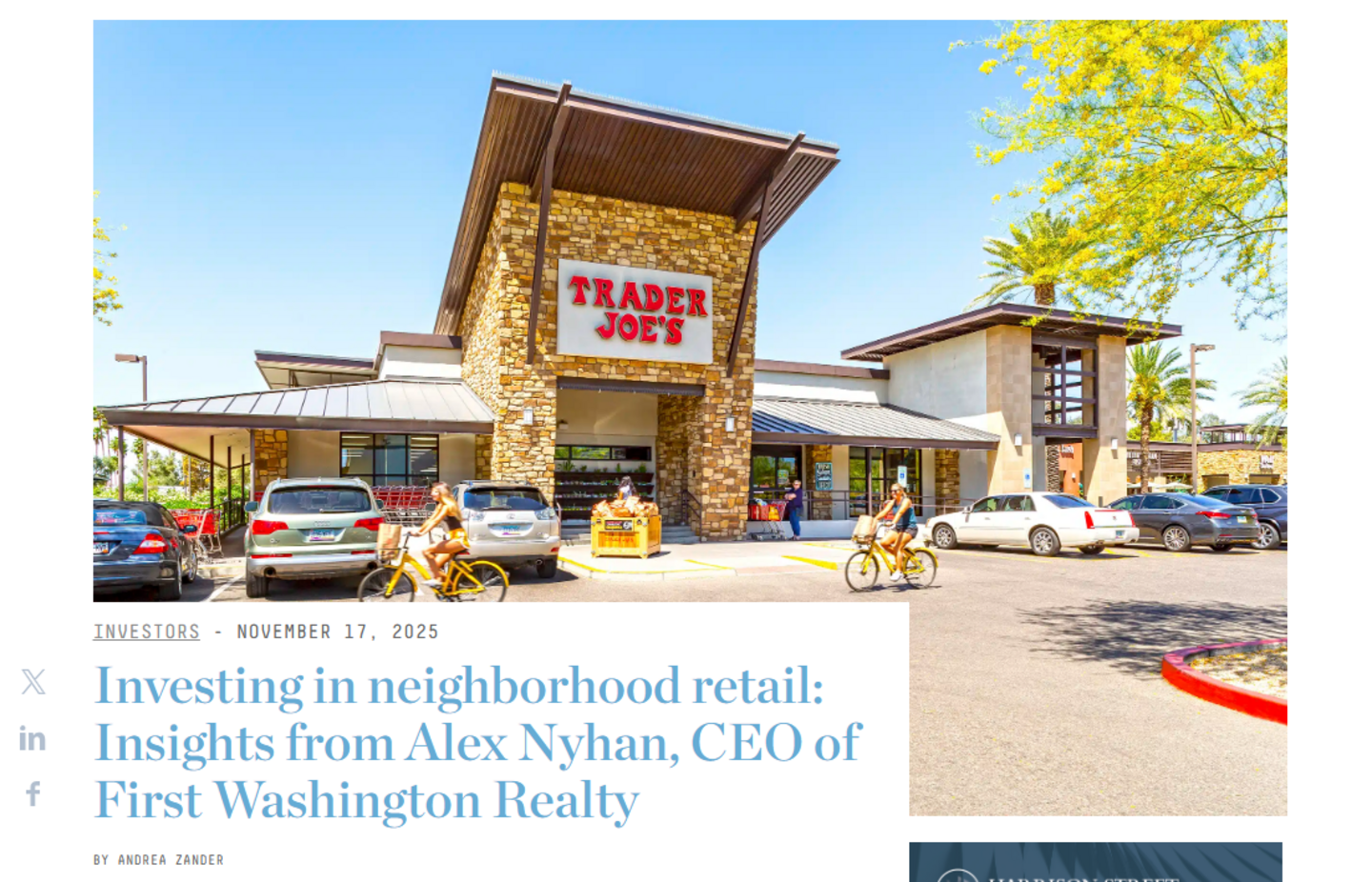
The neighborhood retail sector remains a strong investment, driven by grocery-anchored centers with high-quality tenants and prime locations. Alex Nyhan, CEO of First Washington Realty (FWR), recently explained in an interview with IREI how necessity-driven tenants in neighborhoods with affluent, educated residents and limited competition help sustain performance through both strong and weak economic cycles. This strategy has been tested through multiple market shocks, including the global financial crisis, COVID-19 pandemic, inflation spikes and rising interest rates, demonstrating the enduring stability of grocery-anchored retail.
FWR is a real estate investment firm focused on high-quality grocery-anchored and necessity-based neighborhood shopping centers. The firm manages about $9 billion in assets across more than 138 shopping centers throughout the United States — primarily on the coasts, as well as other markets such as Atlanta, Chicago, Denver, Kansas City, Miami and Raleigh, N.C.
Grocery-anchored and necessity-based retail has held up remarkably well even as other retail categories struggled. What structural factors make this segment so resilient across economic cycles?
We’re a national platform, and we’re privately held. That means when we buy properties or make investments, we’re writing the checks ourselves — which is an important part of our investing philosophy.
We like to joke that we focus on grocery-anchored shopping centers because we’re not smart enough to understand other asset types — but that’s not really true. Many of us, myself included, have experience in other asset classes. This said, since our founding in 1983, we’ve deliberately maintained a singular investment focus – long before grocery-anchored retail became a fashionable investment trend. This consistency over more than four decades has allowed us to build deep relationships with sellers, operators, and tenants, and really master this one strategy rather than being a jack of all trades.
The real reason we focus on grocery-anchored shopping centers is because they tend to hold their value in both strong and weak economic cycles. The asset class has been stress-tested — through COVID, then the inflation spike that followed, rising interest rates, and the ongoing evolution of ecommerce. Each of these stress tests has reinforced the relative attractiveness of grocery-anchored retail compared to some of these other retail formats. That stability, across recessions, rate cycles, and shifts in consumer behavior, is something we’ve witnessed for years in our own portfolio. And as investors, that stability is something we’re very comfortable with.
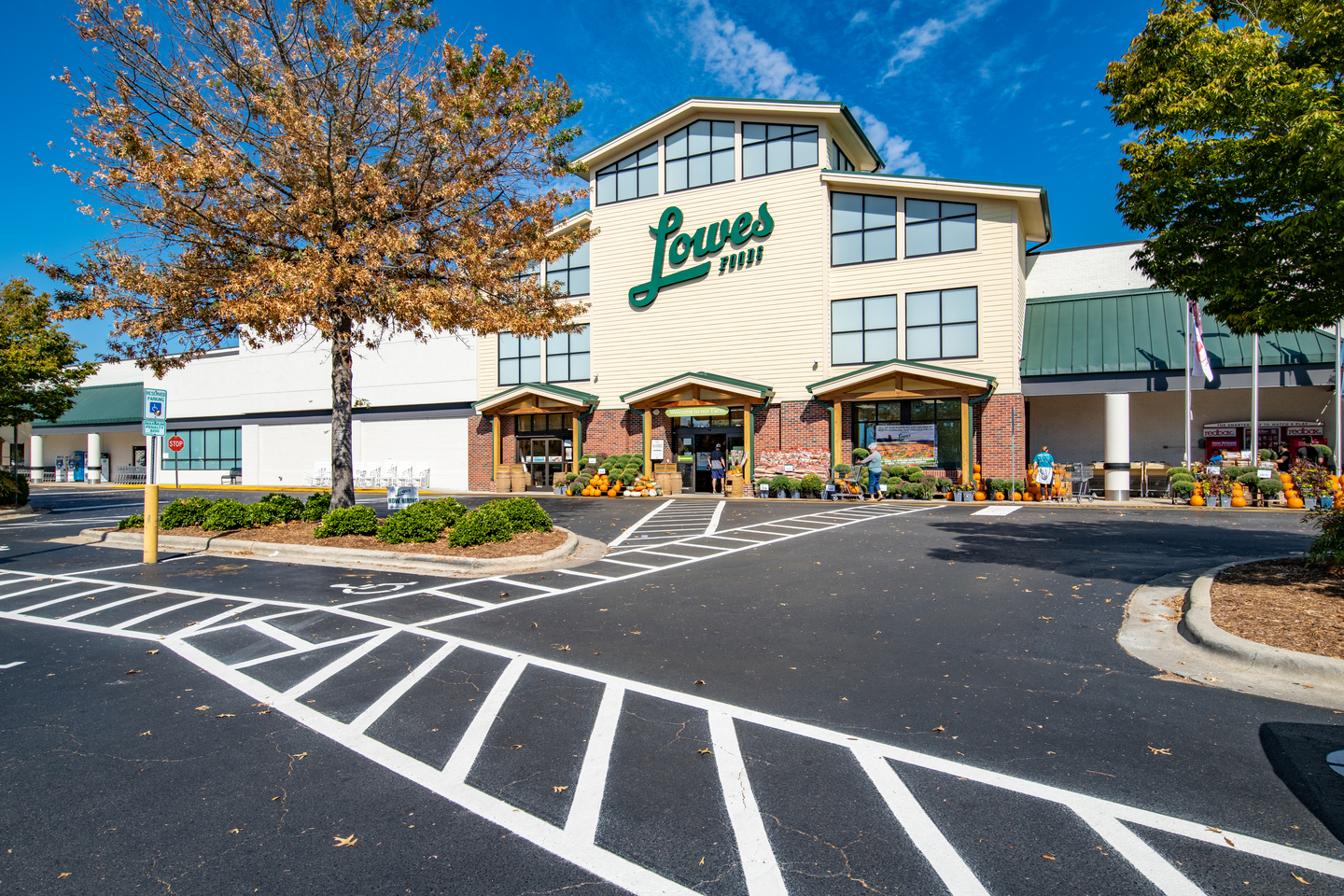
And we believe that stability can be attributed to a very simple fact: we own in neighborhoods with affluent residents who have college degrees and where it’s hard to buy [or] build competing product. The types of tenants we have in our shopping centers are “necessity-oriented tenants”: grocery stores, pharmacies, off-price retailers like T.J. Maxx, and accessible price-point food options like Chipotle or Starbucks. Because those types of retailers represent more than 75 percent of our rent, what that means is approximately 75 percent of rent is highly resilient across economic cycles.
So, whether the economy is good or bad, consumers — even if there are tariffs or macroeconomic uncertainty — consumers still go to our shopping centers. They’re still going to the grocery store. They’re still taking their kids to Taekwondo lessons. They’re still picking up prescriptions at CVS. Neighborhood services are another important component of our business. For example, J.P. Morgan Chase as a bank tenant helps complement smaller tenants, whose rent growth contributes to a higher overall income growth trajectory. Because the vast majority of our revenue comes from necessity-based tenants — and because the people living near our centers continue to spend — consumer confidence in our neighborhoods has stayed strong, even when it has fallen for many others. That is what drives demand and keeps rents rising.
Our portfolio has almost always been between 94 percent and 96 percent occupied. The track record is the product of a consistent strategy over more than 40 years, not a reaction to short-term market trends.
What’s your view on the “retail renaissance” movement, with institutional investors refocusing on the retail segment, and how does that influence your strategy?
Looking back during the past 15 years, between the global financial crisis and the nationwide shut down during the pandemic, these periods represent significant stress tests for retail. Even with tariffs and inflation spikes, occupancy has stayed within a narrow band. These situations have proven the resilience of grocery-anchored retail. For example, eight years ago, malls and open-air retail had about the same occupancy. Today, open-air occupancy has remained the same, but mall occupancy has declined. Many tenants that previously leased in malls are now fleeing and trying to move into grocery-anchored centers, a trend accelerated by COVID. So, both short-term and long-term trends underscore why this property type remains resilient.
Putting that into the context of the “retail renaissance” of today, I’m excited about it. It’s terrific, and a little amusing because we’ve been here executing on that strategy consistently for four decades. Our DNA is based on the understanding that owning high-quality shopping centers and growing rents generates value regardless of the broader economy.
I think what’s happened in the institutional real estate space is that some institutionally favored assets had a huge run-up in value during COVID. Because there were some asset types where everybody ran in and bid up the prices, interest rates rose and values fell, and investors got concerned, and understandably so.
Meanwhile, we’ve kept trucking along with our strategy. I’m delighted that there’s more interest in the sector, and I’m sure there will be some fluctuations in performance, but we’ll just keep sticking to our knitting, which has proven fruitful for our investors.
Are we seeing meaningful new development in this category, or is value being created more through repositioning and redevelopment of existing centers?
We are seeing new developments in this category, specifically in markets like Arizona and Texas. We recently acquired a strong asset in Maryland. That said, we often find we can create attractive risk-adjusted NOI growth by redeveloping existing properties, which is usually more attractive than building new shopping centers from scratch.
But what about the parts of the country with more dynamic economic growth? Are you trying to go there or build new centers?
Except for Boston, we’re invested in all major markets including the Sun Belt, where we’ve seen strong rent and NOI growth. What’s fascinating — and somewhat contrarian for the industry — is our focus on the educational attainment of our customers and supply constraints. When you evaluate those two factors together, some of the markets with the strongest combination of those factors are on the coasts.
How do you view the trend of turning enclosed malls into mixed-use projects?
I think it can make sense, but only when the relative value you can add outweighs the existing property value. For us, the math hasn’t always justified that, but we’re actively exploring those projects in a couple of different shopping centers on the West Coast.
At FWR, our approach is about how we conserve the best of a neighborhood shopping center while also adding value. Take a Kansas City property in which we invested as just one example. There, we worked really hard to recapture a Macy’s that was originally planned for an office-over-retail conversion. After leveraging our research, it made more sense to convert the top floor into a second level of retail.
All this to say, we are essentially agnostic — our decisions are center specific and are guided by what can create the strongest economic outcome for a center.
Given today’s higher interest rate environment and constrained capital markets, how has FWR adapted its investment or financing strategies to maintain growth and performance?
Growth and performance are very different things.
Philosophically, when it comes to investing, you have to ask yourself whether the institutional environment in the United States and globally feels settled and simple, or unsettled and complex. For a variety of well-documented reasons, the environment today is clearly the latter.
Given that backdrop, I believe the way to protect performance is simple: stick with very high-quality assets — which is exactly what we buy — and focus on growing rents without spending too much capex, because the only solution to preserving value when you have inflation is growing income.
On the growth side, I think you need to be selective in what you buy. This year, for example, we’ve bid on more than $300 million of product, but only closed on one asset. So, we sought to maintain discipline and only transact where we saw a real quality product with significant upside opportunity.
In short, in an uncertain environment, the only answer is quality and NOI growth. And that philosophy guides both how we acquire new assets and manage our existing portfolio.
FWR has outperformed through multiple market cycles over four decades. What are the enduring elements of the firm’s investment philosophy that allow it to do so?
We really have a spirit here of intellectual modesty. What I mean by that is, we don’t believe it’s possible to predict trends in real estate. We’re sort of cheerful pessimists when it comes to the economy, and that’s why we only own assets we feel truly comfortable owning, whether the economy is doing well or doing poorly. We’re happy to let others predict trends, while we stay focused on what we know best, which is high-quality, necessity-based retail that delivers durable returns.
We’re disciplined about high quality not because we think it’s trendy or cool — it’s because you never know if the economy is going to be in a good or bad place, but if you have the best shopping center, you can still attract tenants and grow rents, pretty much regardless of what’s happening in the economy. That comfort also extends to location. If there are four neighborhood shopping centers on a corner, it’s important to us to own the best corner.
A good example is thinking about tariffs as the new inflation. If you want to ask how these tenants are going to perform with tariffs, rewind a few years. The CEO of T.J. Maxx said it recently — we’ve all seen this movie before. Go back to the last inflation period, and those essential retailers not only grew their sales, they actually expanded operating margins, even with inflation, because of supply and demand dynamics. So, when I see that data for our tenants, it gives me confidence that, no matter what happens with tariffs or inflation, they’ll perform well.
Finally, being private is important to us. There’s nothing that clears the mind like having to write a check. We bought Donahue Shriber about three and a half years ago in what was the biggest private open-air shopping center transaction in U.S. history. When you buy a company at that scale especially, but in any deal, it’s a commitment that creates a personal connection to the real estate outcome and reinforces the discipline that has guided out investment process for over 40 years.
As a vertically integrated real estate investment firm, how does that structure enhance FWR’s ability to create value compared to more traditional or externally managed platforms?
We’ve roughly doubled the number of people here over the last few years. We’ve expanded from offices in Bethesda [Md.] and Kansas City to San Diego, Seattle, Sacramento and Orange County [Calif.]. What’s been so great about that is bringing in people with diverse experience and skillsets that help us grow.
In the markets where we’re active, we need to be able to hire people from all walks of life who can challenge our thinking and make us better. We’re not perfect and have a lot to improve, but one thing we do very well is attract people who are smart and passionate about what they do — and give them space to challenge the rules and go for it.
That’s what vertical integration really means for us — people working across development and investments as one team, pushing each other for better outcomes. The real differentiator is having a team that’s aligned, curious and constantly pushing to get better.
What is your outlook for 2026?
We are always focused on growing rents and improving merchandising to reflect the current state of supply and demand dynamics. The good news is that tenant demand remains incredibly strong. Retailers continue to prioritize open-air centers as they become “omni-channel” and flee enclosed malls. I feel very comfortable with the tenant demand side of the equation.
The bigger question is what happens in the macroeconomy and what that means for pricing. Regardless, we will continue to grow selectively and stay disciplined. Whatever the environment looks like in 2026, we’ll let it inform where the buying opportunities are.